North Star Sounds 5.19.26
PRO TIP - CLICK THIS HEADLINE TO READ AND LISTEN IN THE SUBSTACK APP OR IN YOUR BROWSER

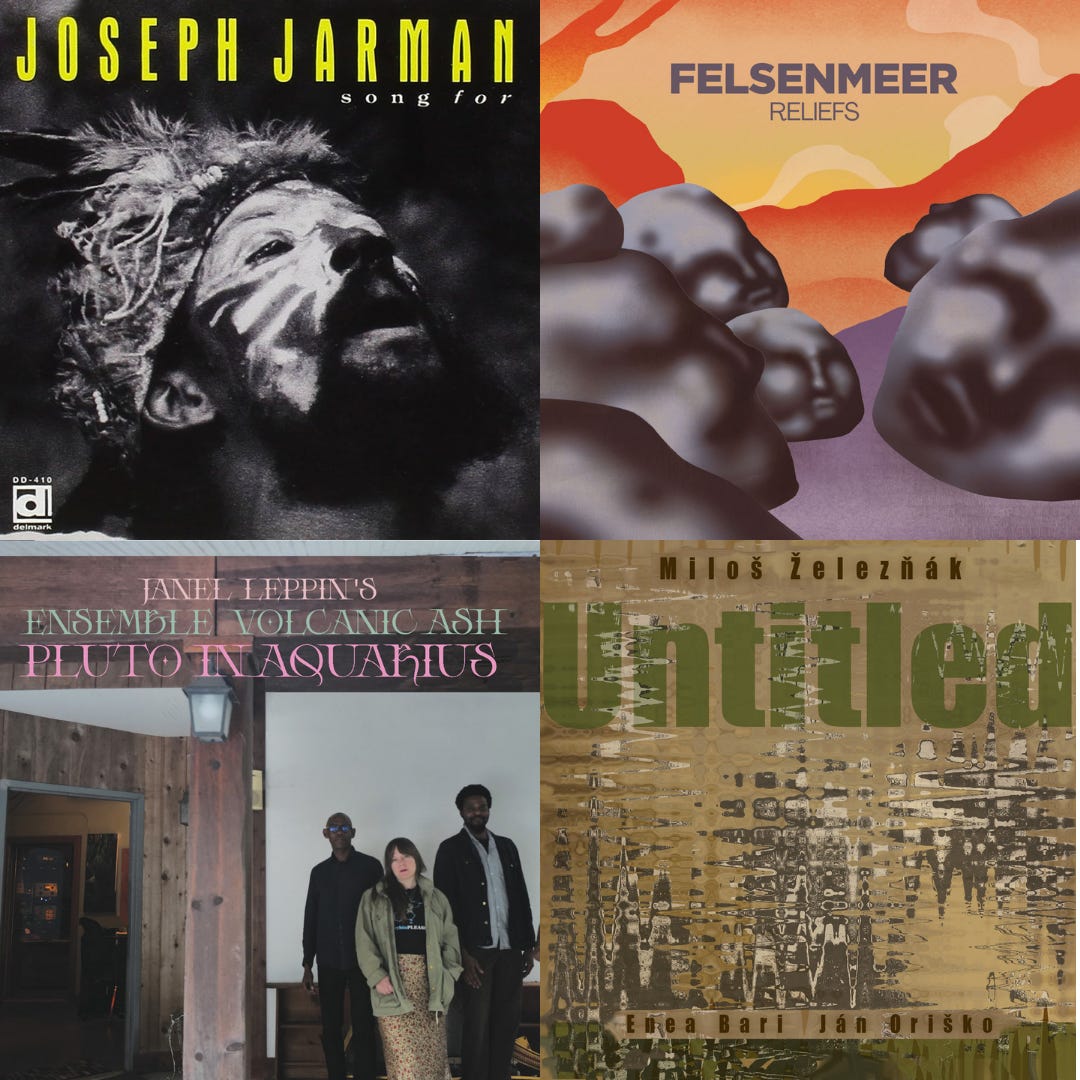
The groundbreaking Non-Cognitive Aspects of the City with the late Joseph Jarman; rummaging for fundamental truths with Portuguese bassist João Madeira's improv quartet (w/ cellist Fred Lonberg-Holm!); angular dancing with Slovak guitarist Miloš Železňák's trio; an exciting proggy blend from Joséphine Besançon’s Felsenmeer; and the latest from DC-based cellist Janel Leppin! AND MORE!!
Tuesday’s radio transmission is archived on Mixcloud here.
In my oversimplified mental map of the evolution of “free jazz” I’ve got Ornette and Cecil Taylor in the 1950’s pushing past the conventions of the jazz standards’ song forms and functional harmony, Sun Ra moving to NYC and continuing that reconstruction project in the early 1960s while Sunny Murray (DE)constructed the notion of pulse itself with Albert Ayler. If this were a Schoolhouse Rock cartoon, this Eisenhower/Kennedy era would be Part one. Part two would take place in mid-60’s Chicago, in Delmark’s North Michigan Avenue studio with Roscoe Mitchell, Joseph Jarman and their AACM colleagues loading in all their little instruments. George Lewis, in A Power Stronger Than Itself cites a Tape Op article describing the difficulty the engineer’s faced when confronted with Mitchell and Jarman’s music - a much broader dynamic range, given the many “little instruments” and the lack of “soloists.” How do you mic and mix this stuff? I love how this studio engineering lens frames the expansion of the music’s vocabulary. For this composition, Non-Cognitive Aspects of the City, Jarman brought his working band: Thurman Barker, Charles Clark and Christopher Gaddy into the studio. Jarman recited his text which ends:
these states on planes
farout as these lives become
thoughts
final lasts works there
spots for treason
last word
non-cognitive
doom
The Sephardics are a German quartet fusing jazz and other elements with the Spanish and Portuguese Jewish (Sephardic) musical tradition. The Sephardic Dialogues is a stylistically broad 3 disc release. The first disc is collaboration with Biensüre, a Marseille-based group focused on Turkish and Kurdish disco. Part III brings in Elliot Sharp for something completely different. Part II splits the difference, with Australian German guitarist Oren Ambarchi and Indian German percussionist Ramesh Shotham. And no, for the record, I don’t think the “Love Supreme” quote in “Rosa” is hokey. There is SO much on these 3 discs. I’m still digesting it.
Slovak guitarist Miloš Železňák moody trio recording came out on the Italian Caligola Records label a couple of years ago. This is the composition entitled Unidentified. I love how the math-prog section spills into a lovely slow 6/8 dance (bringing to mind the feel of the instrumental parts of that first Hatfield & the North album). And I don’t know who is playing the vibes. Not listed.
Oh man, there’s so much exciting territory covered on cellist Janel Leppin’s Ensemble Volcanic Ash albums! Leppin’s singular vision is the connecting thread for all this work. On the first few cuts of this recent release Leppin’s dab of reverb brings some cinematic drama to the proceedings. She also deploys her distortion pedal to good effect (an effect that she also mines on her solo album, released this month on Cuneiform Records as well). Ensemble Volcanic Ash is Janel Leppin – cello, Larry Ferguson – drums, Anthony Pirog – guitar, Brian Settles – tenor saxophone, Luke Stewart – bass.
More from the proggy end of the jazz continuum. This one is from Parisian-based clarinetist Joséphine Besançon’s ensemble, Felsenmeer. The album came out last month on Aut Records. Much of Felsenmeer’s music is composed but the looseness and laying back on the beat reads as jazz. The choral vocal sections are gorgeous and compelling.
Hamid Drake helps elevate the proceedings here, and everybody shifts into a higher gear when he kicks in on these improvisations. There’s Nicole Mitchell’s searching and spellcasting flute, Rhodrie Davies’ harp, but also Matthew Wright’s turntables and live sampling to add some grit with Hawkinss’ synths and sampler. No Nation But Imagination is out on Intakt today.
There’s some caffeinated sand in this free improv oyster, for sure. Drummer Bruno Pedraso makes sure nobody hardens into a set pulse. The strings on this session meld nicely like a three-headed sea cucumber: bassist João Madeira, violinist Carlos “Zíngaro,” and cellist Fred Lonberg-Holm speak in painful undulations and death bed declamations. Whole truths discovered.

Tuesday’s semi-ancient vinyl nugget of transformation was Ken McIntyre’s Home, recorded in 1975 for the Danish Steeplechase label and licensed, like many Steeplechase albums, to Inner City Records. Inner City was an interesting label that released hundreds of albums from the mid 70’s through 1980, releasing a wide variety of styles, including reissues of classic recordings. At the time of this recording, McIntyre was teaching at the African American Music department at SUNY Old Westbury, near where I grew up on Long Island. McIntyre taught there for a few decades (I would like to get in a time machine and sit in on his classes). The album is a great example of a type of 1970’s post bop that stays within the tradition but absorbs a variety of forms and genres into the tradition’s aesthetic (although many of these compositions were penned by McIntyre in the early 1960s). For this date McIntyre brought in Jaki Byard, Andrei Strobert and Reggie Workman, who seems to be playing through one of those Ampeg B15s that were ubiquitous at the time. In the liner notes, McIntyre lays out the fraught sexual associations with the term jazz, making the case that this is music in the African American tradition and that the term jazz is not something the original practitioners used for their music. The white musicians of the Original Dixieland Jazz Band seemed to have opened up the term for popular usage. Fast forward to the next century and we’re still juggling usage of the word jazz like a hot potato. (Lewis Porter devoted seven Substack posts to the derivation of the term.)